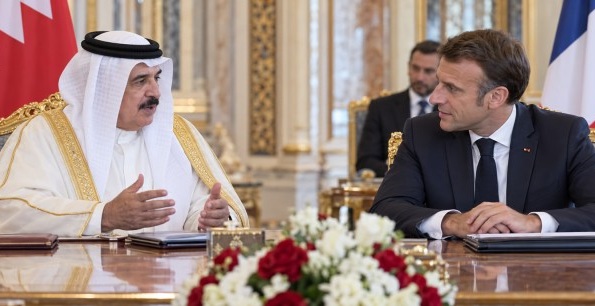
Bahrain and France have taken significant steps to bolster their strategic partnership, with a focus on enhancing cooperation in defense, energy, and technology. During official talks, Bahrain’s King Hamad bin Isa Al Khalifa and French President Emmanuel Macron discussed strengthening bilateral relations to support shared economic and security interests, as well as addressing regional challenges.
A key outcome of the discussions was the emphasis on defense and security collaboration. Both leaders highlighted the importance of protecting their countries and enhancing regional stability. King Hamad condemned recent Houthi attacks against Saudi Arabia and reaffirmed Bahrain’s support for the kingdom. Macron reiterated France’s commitment to regional security, emphasizing cooperation with Bahrain in defense and security matters.
The talks also covered energy security, with both nations underscoring the need for reliable energy supplies. A notable development was the signing of a memorandum of understanding on the peaceful use of nuclear energy. This agreement aims to develop Bahrain’s civilian nuclear energy capabilities through training and knowledge exchange, marking a step forward in Bahrain’s energy strategy.
In addition to defense and energy, the leaders explored opportunities for joint projects in industry and transportation, including a proposed railway network connecting Bahrain with other Gulf Cooperation Council (GCC) countries. Macron highlighted potential industrial collaborations, specifically mentioning partnerships with Aluminium Bahrain (Alba).
King Hamad awarded Macron the Collar of the Order of Shaikh Isa bin Salman Al Khalifa, Exceptional Class, recognizing his efforts to strengthen ties between the two nations. The meeting underscored both countries’ commitment to deepening their strategic partnership, with a focus on advancing cooperation across various sectors, including sustainable development and scientific research.
The discussions also touched upon regional and international developments, particularly in the Middle East, with both leaders advocating for peace based on respect for national sovereignty and international law. They reiterated the importance of dialogue and cooperation through the United Nations to address issues, including the Palestinian conflict, supporting a two-state solution.